
Across the modern digital economy, applications drive virtually every business function.From banking platforms and e-commerce systems to AI-driven services and cloud platforms, organizations rely heavily on web applications and APIs. However, as digital adoption grows, so do cyber threats targeting software vulnerabilities.
One of the most influential organizations working to address these risks is OWASP. OWASP plays a critical role in helping organizations understand, prevent, and mitigate application security vulnerabilities. Its frameworks, tools, and research have become industry standards used by security teams, developers, and enterprises worldwide.This write-up explores what OWASP is, why it matters, and how its resources help organizations build secure applications.
What is OWASP?
The Open Web Application Security Project (OWASP) is a global nonprofit organization dedicated to improving the security of software applications. Unlike commercial security vendors, OWASP operates as an open community where security professionals, developers, researchers, and organizations collaborate to create freely available security resources.
OWASP’s mission is simple but powerful: make software security visible so organizations can build safer applications. The organization provides guidance through documentation, security frameworks, community projects, and open-source tools. These resources help developers and security teams identify risks early in the development lifecycle and implement effective protection mechanisms. OWASP resources are used by startups, fintech companies, governments, and global enterprises to strengthen application security strategies.
Why Application Security Matters
Modern applications are complex systems composed of multiple components, including APIs, databases, authentication systems, and cloud infrastructure. This complexity increases the number of potential vulnerabilities attackers can exploit.
Common application threats include:
- Injection attacks
- Broken authentication
- Data exposure
- API abuse
- Misconfigured security controls
These vulnerabilities can lead to severe consequences such as data breaches, financial fraud, and service disruptions. For industries like fintech, healthcare, and e-commerce, application security is not just a technical requirement; it is a business necessity. A single vulnerability can expose sensitive customer data, disrupt payment systems, or damage brand reputation. This is where OWASP provides essential guidance.
The OWASP Top 10
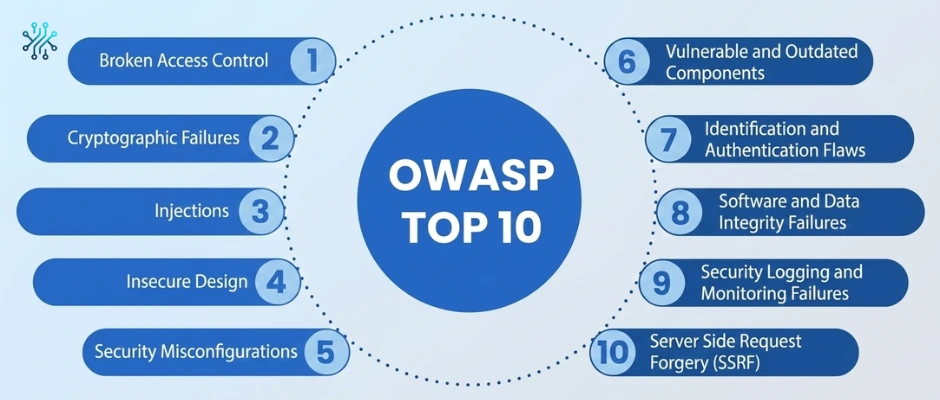
One of the most widely recognized OWASP projects is the OWASP Top 10. It identifies the ten most critical security risks affecting modern web applications.
The OWASP Top 10 serves as a reference point for developers and security teams worldwide.
Some key risks highlighted in the list include:
Broken Access Control
When applications fail to properly enforce access restrictions, attackers may gain unauthorized access to sensitive data or functionality.
Cryptographic Failures
Improper use of encryption can expose sensitive information such as passwords, payment details, or personal data.
Injection Attacks
Injection vulnerabilities allow attackers to manipulate backend systems by inserting malicious commands into application inputs.
Security Misconfiguration
Incorrectly configured servers, frameworks, or cloud environments often create exploitable security gaps.
Vulnerable Components
Applications frequently depend on third-party libraries and open-source components. If these components contain vulnerabilities, the entire system may become exposed. Organizations use the OWASP Top 10 as a baseline security checklist during application development and security testing.
OWASP API Security
With the rapid adoption of cloud services and microservices architectures, APIs have become the backbone of modern applications. However, APIs also introduce new security challenges. OWASP addresses this through the OWASP API Security Top 10, a specialized list focused on API vulnerabilities.
Some common API risks include:
- Broken object-level authorization
- Excessive data exposure
- Lack of rate limiting
- Broken authentication
- Mass assignment vulnerabilities
For fintech startups and payment platforms, API security is particularly critical because APIs handle financial transactions, identity verification, and customer data. By following OWASP API security guidelines, organizations can significantly reduce the risk of unauthorized access, data leakage, and fraud.
OWASP Tools and Security Frameworks
OWASP is not limited to theoretical research. The organization also provides practical tools and frameworks that help teams implement security controls.
Application Security Verification Standard (ASVS)
The OWASP ASVS provides a comprehensive framework for verifying application security requirements. ASVS helps organizations define security controls across areas such as:
- Authentication
- Access control
- Cryptography
- Input validation
- Error handling
It is commonly used by security teams to perform structured application security assessments.
Software Assurance Maturity Model
Another important framework is the OWASP SAMM. SAMM helps organizations measure and improve the maturity of their secure development practices. It focuses on integrating security throughout the software development lifecycle rather than treating it as a final testing step. SAMM evaluates organizations across several domains, including governance, design, implementation, and operations.
OWASP in Fintech and Payment Security
For fintech startups and digital banking platforms, application security is a critical priority. Payment systems process sensitive financial data and must meet strict regulatory requirements.
OWASP frameworks provide valuable guidance in areas such as:
- Secure API authentication
- Data encryption standards
- Input validation mechanisms
- Fraud detection integration
- Secure session management
By aligning development practices with OWASP recommendations, fintech companies can build secure payment infrastructures that protect users and maintain regulatory compliance.
OWASP and the Future of Security
As technology evolves, OWASP continues expanding its research to address new challenges such as cloud security, container security, and artificial intelligence risks. With the growing adoption of generative AI, OWASP has also introduced guidance on securing AI applications, including the OWASP Top 10 for Large Language Model Applications. This framework identifies emerging threats such as prompt injection, data leakage, and model manipulation. These developments highlight OWASP’s role in shaping the future of cybersecurity by addressing both traditional software vulnerabilities and emerging technologies.
Building a Security-First Development Culture
Implementing OWASP guidelines is not only about using security tools or performing occasional vulnerability scans. The most successful organizations adopt a security-first development culture. This means integrating security practices throughout the software lifecycle, including:
- Secure coding training for developers
- Automated security testing in CI/CD pipelines
- Continuous vulnerability monitoring
- Strong identity and access management controls
By embedding security into every stage of development, organizations can detect vulnerabilities early and reduce the risk of costly breaches.
Conclusion
Application security has become one of the most critical challenges facing modern organizations. As digital platforms continue expanding, vulnerabilities in web applications and APIs create significant risks for businesses and their customers.
OWASP provides one of the most trusted and widely adopted resources for addressing these challenges. Through initiatives like the OWASP Top 10, API Security Top 10, ASVS, and SAMM, the organization helps developers and security professionals understand vulnerabilities and implement effective protections.
By adopting OWASP frameworks and integrating security into the development lifecycle, organizations can build resilient applications that protect sensitive data, maintain customer trust, and support long-term digital growth.
In a world where software powers everything from financial transactions to AI-driven systems, following OWASP guidance is no longer optional; it is essential. If you’d like to discuss in detail, let’s connect or drop a comment below.